By: Peyton McDermott
Perhaps a large majority of our University Preparatory student population remains ineligible to vote at the present, but it is of equal importance to advocate for pre-registration, registration, as well as for education on the election and its circumscribed races as a whole. It is a critical period of time at the present, wherein the 2026 US elections are a mere 3 days away—and it’s thus the time of encouragement for all of those who are eligible to guarantee their voting status and to get informed on what’s on the ballot this midterm. Once one has registered/pre-registered to vote, verified their registration status, understood the electoral process, and made a voting plan, they may consider themselves effectively prepared.
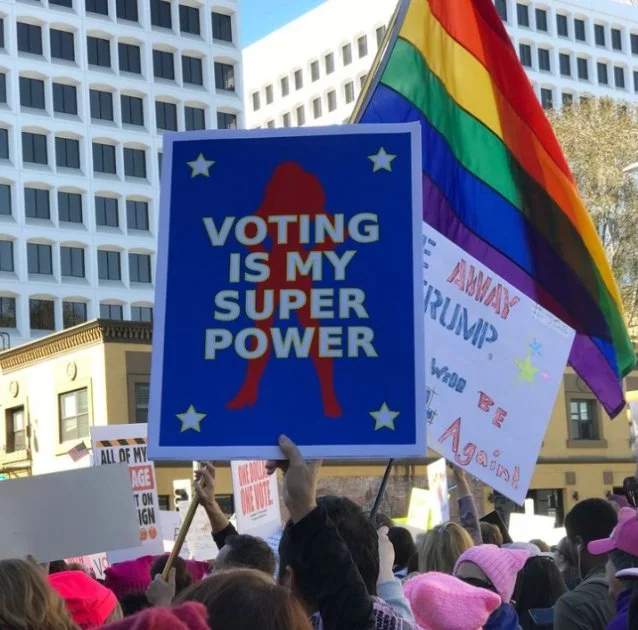
Foremost, this upcoming midterm election (general elections that are held at the midpoint of the concurrent presidential term) occurs on Tuesday, November 3rd, and will deliver approximately 40 candidate races as well as 15 ballot measures to vote on. Ballots span proposals on a federal, state, and local level. While local elections may often seem lesser in the grand scheme of things, these measures and officials instead impact an individual most directly: such as the decision to appoint officers within our, and surrounding, school districts. Each level of voting is of an equivalent significance, if not for an immediate effect on our own lives, but for all else. Every election often has one, or various, defining issues which regularly shape the key races and election results. It’s been purported, per Britannica, that the prevailing issues this year are “the economy and immigration.” With these issues in the minds of voters, the policies up for election may see a significant shift.
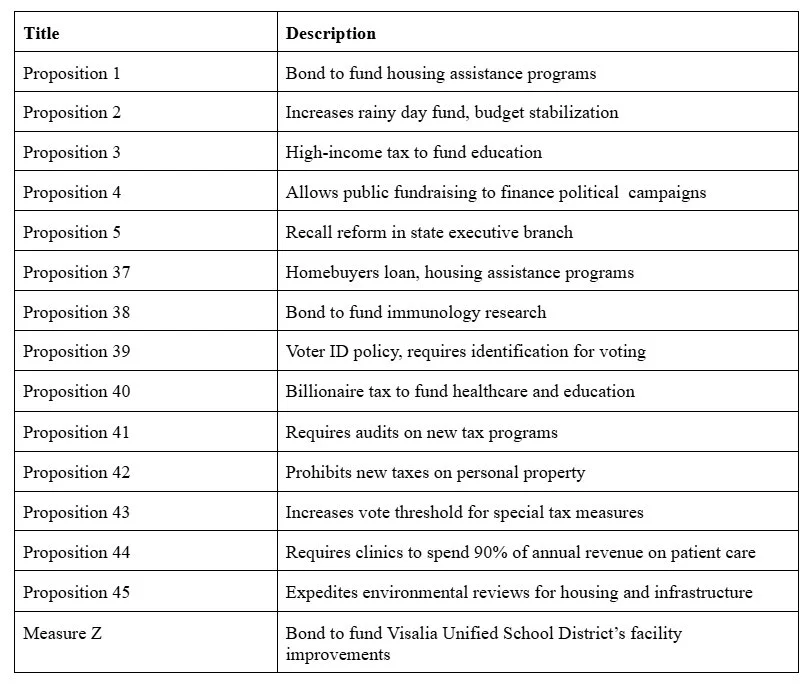
In this regard, measures—or otherwise laws, issues, and propositions—are a powerful and often overlooked factor within state and local law. This year, 15 policies are up for the review of voters in California. On a state level are Propositions 1-5, 38-45; on a local level is Visalia Unified School District’s Measure Z. These measures were examined in Mr. Figuerora’s Economics class, wherein students were paired to present their chosen proposition alongside their concluding, agreed-upon verdict—altogether issuing peers with an incentive to vote. Included is a table, with brevity, which represents each measure (for more expansive insight into any of these such measures, refer to a choice formal source, such as CalMatters or Ballotpedia):
Furthermore, included on an electoral ballot are the candidates: spanning federal candidates for the US Senate, House, and Governor, as well as various local officials. California does not participate in a Senate race, having last elected Senator Adam Schiff in 2024 to serve a six-year term. However, the officials voted on in California—as well as locally—are the California Governor; seven positions for the US House of Representatives; two Visalia City Council seats for Districts 4 and 5; two positions in Visalia Unified School Districts Areas 1 and 4; as well as electing an officer to the seat of Tulare County Board of Education, Tulare County Board of Supervisors, and Tulare Local Healthcare District.
To conclude, voting is a critical aspect of civil action: advocating for the betterment of communities, individuals, and the system of democracy as a whole. Voters not only shape policies and laws, but they also have the power to elect officials who will make decisions on their own behalf on a larger-scale; elected officials, when decided through this process of educated voting, decide on the priorities of their people—what’s more important than being an informed citizen and voting for the representatives who best align with their values? If you didn’t have the opportunity to vote in this midterm election, make a plan to register for the next election to follow: the presidential election falling on November 7, 2028!
